100 Days Of Machine Learning: A Complete Guide
Machine learning is transforming the world around us—from the music recommendations you receive to the voice assistants on your phone. But what exactly is machine learning, and how does it work? In this guide, we’ll explore machine learning from the ground up, using simple examples and clear explanations that anyone can understand.
What is Machine Learning?
How Do Humans Learn?
Think about how you learned to recognize your favorite foods, or how you know which songs you’ll enjoy. You didn’t memorize a rulebook—you learned from experience. Every time you tried something new, your brain remembered whether you liked it or not. Over time, you got better at predicting what you’d enjoy based on your past experiences.
This is natural learning: using what we’ve learned from the past to make smarter decisions in new situations.
How Do Machines Traditionally Work?
Now, what about computers? Traditionally, computers are very different from humans. They don’t learn—they follow instructions. If you want a computer to do something, you need to program it with exact, step-by-step commands.
For example, if you wanted a computer to identify spam emails, you’d have to write rules like:
- “If the email contains the word ‘free money,’ mark it as spam”
- “If the sender’s address looks suspicious, mark it as spam”
But what happens when spammers change their tactics? You’d have to update all your rules manually. The computer can’t adapt on its own.
The Problem with Traditional Programming
Here’s where we run into serious limitations:
The world is too complex for simple rules.
Imagine trying to write rules for every possible situation:
- How would you write rules to identify thousands of different dog breeds in photos?
- How would you create rules to predict which movies someone might like based on their viewing history?
- How would you program a computer to drive a car safely in all weather conditions, on all road types, with unpredictable traffic?
You’d need millions of rules, and even then, you’d miss countless edge cases and exceptions. Traditional programming simply breaks down when problems become too complex or when we need computers to handle new, unseen situations.
So How Can We Solve This Problem?
What if, instead of programming every single rule, we could train machines to learn from data—just like humans learn from experience, but much, much faster?
This is exactly what machine learning does. It allows computers to:
- Analyze past data
- Find patterns on their own
- Make predictions about new situations
- Improve their accuracy over time
Machine learning isn’t just about memorizing information—it’s about understanding patterns and reasoning from them.
Example: Paul and His Music Choices
Let’s use a real-world example to see how machine learning actually works.
Meet Paul. Paul loves discovering new music. Every day, he listens to songs and decides whether he likes them or not. But what influences his decision?
Paul’s preferences depend on several factors:
- Tempo: How fast or slow the song is
- Genre: The style of music (rock, jazz, pop, etc.)
- Intensity: How powerful or gentle the music feels
- Gender of voice: Male or female vocalist
That’s a lot of factors! But to keep things simple, let’s focus on just two: tempo and intensity.
Visualizing Paul’s Preferences
Imagine we create a graph:
- The X-axis shows tempo (from relaxed to fast)
- The Y-axis shows intensity (from light to soaring)
Now, let’s plot Paul’s past choices on this graph. We find that:
- Paul likes songs with fast tempo and soaring intensity
- Paul dislikes songs with relaxed tempo and light intensity
Scenario 1: An Easy Prediction
Paul listens to a new song called Song A. It has fast tempo and soaring intensity. When we plot Song A on the graph, it falls right in the area where all of Paul’s liked songs are.
Can we predict whether Paul will like Song A?
Absolutely! Based on his past choices, it’s very clear that Paul will like this song. This is a simple case of classification—matching new data to existing patterns.
Scenario 2: An Unclear Prediction – Where Machine Learning Shines
Now Paul listens to another new song called Song B. This song has medium tempo and medium intensity.
When we plot Song B on the graph, we face a problem: it falls in an ambiguous area, somewhere between the songs Paul liked and the songs he disliked. There’s no clear pattern.
How do we predict whether Paul will like Song B?
This is exactly where traditional programming fails and machine learning succeeds.
How Machine Learning Helps
Here’s what machine learning does:
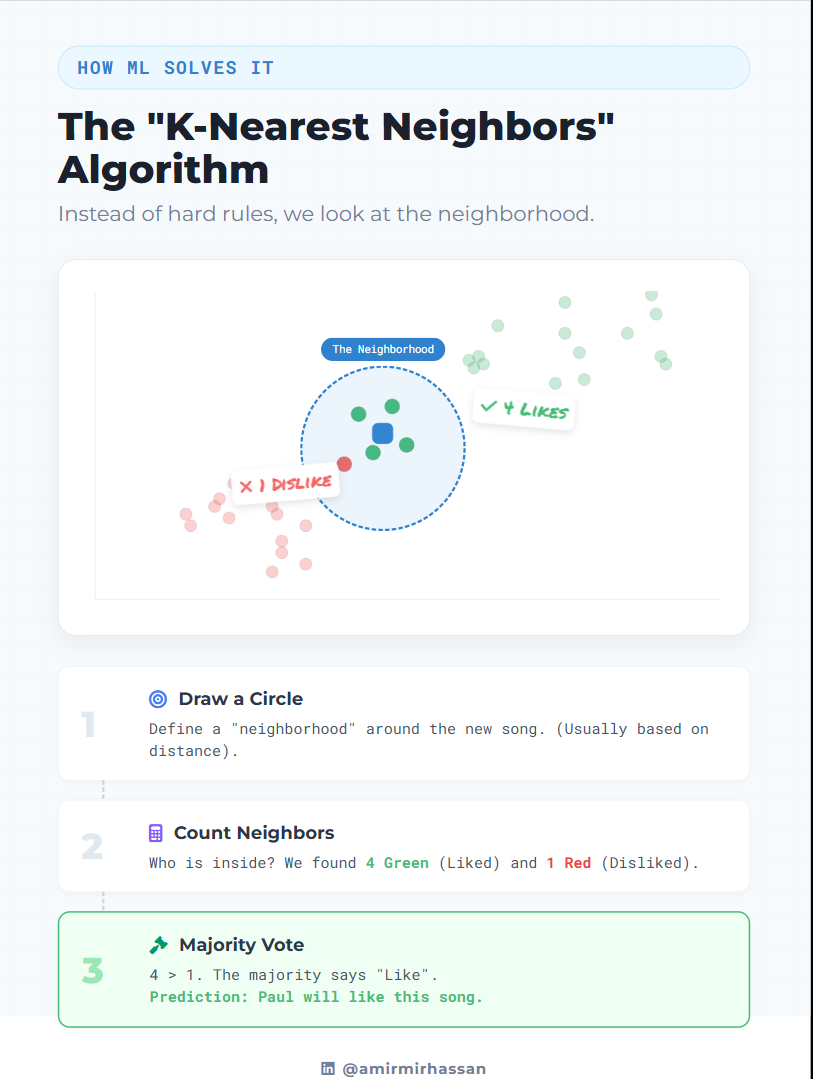
- Look at the neighborhood: Draw a circle around Song B
- Count the nearby votes: See which songs are closest to Song B
- Inside the circle, there are four songs Paul liked
- Inside the circle, there is one song Paul disliked
- Go with the majority: Since there are more “like” votes (4) than “dislike” votes (1), we predict that Paul will definitely like Song B
This simple but powerful method is called the K-Nearest Neighbors algorithm—one of the fundamental techniques in machine learning.
How Machine Learning Models Work
Let’s summarize what machine learning does:
- Learns from data: When choices become complicated and unclear, machine learning analyzes all available past data
- Builds a prediction model: It identifies patterns and creates a mathematical model
- Makes predictions: When new, unclear data points come in, the model can predict outcomes based on learned patterns
- Improves with more data: The more data available, the better the model becomes, and the higher the accuracy of predictions
This is the core idea behind machine learning: teaching computers to learn from experience rather than following rigid, pre-programmed rules.
Types of Machine Learning
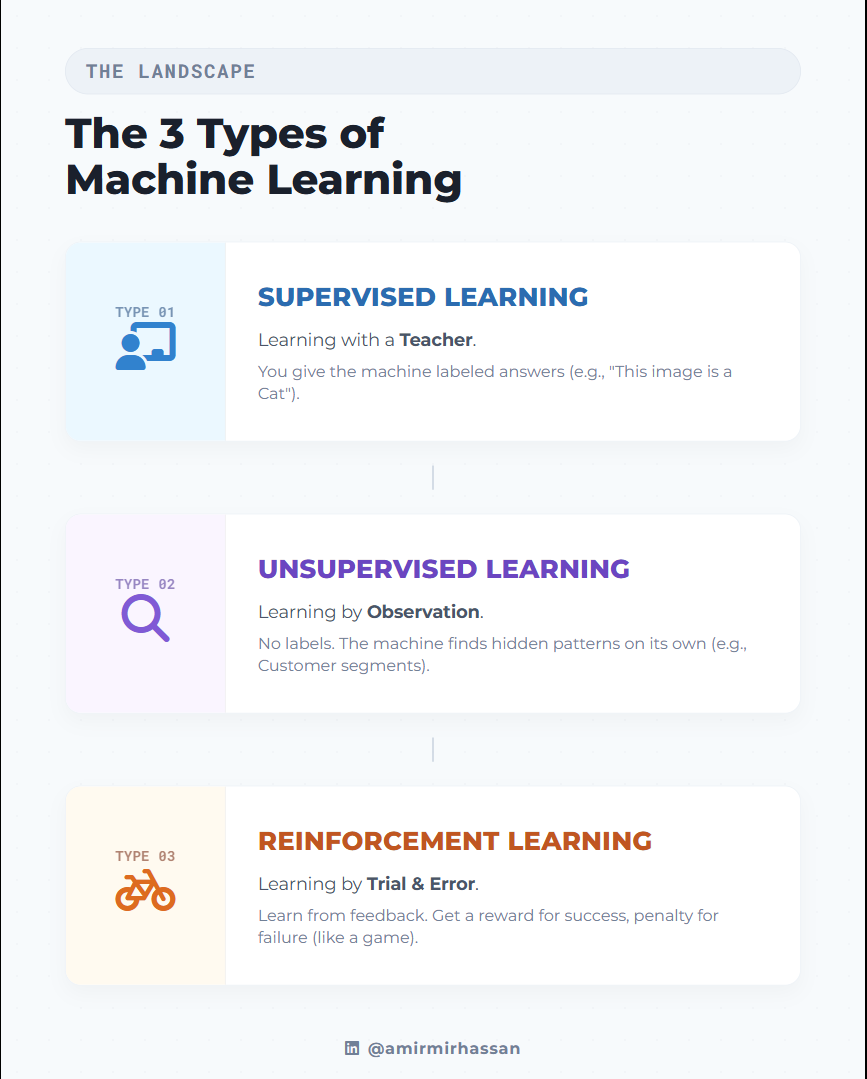
Just as humans can learn in different ways—through instruction, observation, or trial and error—machines can also learn through different approaches. There are three main types of machine learning:
- Supervised Learning
- Unsupervised Learning
- Reinforcement Learning
Let’s explore each one.
Supervised Learning
What’s the core idea?
Supervised learning uses labeled data to train the model. This means the machine is given input data along with the correct answer (or “label”) for that data. It’s like learning with a teacher who tells you the right answers.
Example: Classifying Coins by Weight
Imagine your friend gives you one million coins from three different currencies:
- One Rupee coins
- One Euro coins
- One Dirham coins
Each type of coin has a different weight:
- One Rupee coin weighs 3 grams
- One Euro coin weighs 7 grams
- One Dirham coin weighs 4 grams
Your goal: Build a model that can predict the currency of any coin based solely on its weight.
How does supervised learning work here?
First, let’s understand the terminology:
- Feature: The weight of the coin (this is the input information we measure)
- Label: The currency type (this is the correct answer we want to predict)
When you feed this data to the machine learning model—pairing each weight with its corresponding currency—the model learns the associations:
- “If a coin weighs 3 grams → it’s a 1 Rupee coin”
- “If a coin weighs 7 grams → it’s a 1 Euro coin”
- “If a coin weighs 4 grams → it’s a 1 Dirham coin”
Now, when you give the trained model a new coin, it can measure the weight and predict the currency accurately.
Key takeaway: In supervised learning, the machine knows both the features of the object (like weight) and the labels associated with those features (like currency). It learns by studying many examples where the correct answer is already provided.
Unsupervised Learning
What’s the core idea?
Unsupervised learning deals with unlabeled data. The machine is given input data without any corresponding labels or correct answers. Its job is to find patterns, structures, or groupings within the data entirely on its own. It’s like learning by observation, without a teacher.
Example: Classifying Cricket Players
Suppose you have a cricket dataset for various players, containing:
- Runs scored by each player
- Wickets taken by each player
You feed this dataset to the machine without telling it anything about player types or categories.
What happens?
The machine plots this data:
- Wickets on the X-axis
- Runs on the Y-axis
By analyzing the plotted data, the machine discovers two distinct clusters (groups):
- Cluster 1: Players who scored many runs but took very few wickets
- Cluster 2: Players who scored few runs but took many wickets
You can then interpret these clusters based on your cricket knowledge:
- Cluster 1 = Batsmen (players who specialize in scoring)
- Cluster 2 = Bowlers (players who specialize in taking wickets)
The important point: There were no labels like “batsmen” or “bowlers” in the original data. The machine discovered these natural groupings completely on its own by finding patterns in the numbers.
Key takeaway: Learning with unlabeled data—where the machine finds hidden patterns without being told what to look for—is called unsupervised learning.
Reinforcement Learning
What’s the core idea?
Reinforcement learning works on the principle of feedback and rewards. The machine learns by interacting with an environment, trying different actions, and receiving:
- Rewards for desired actions (positive feedback)
- Penalties for undesired actions (negative feedback)
Over time, the machine learns to maximize rewards and minimize penalties. It’s like learning through trial and error, similar to how you learned to ride a bicycle.
Example: Image Identification
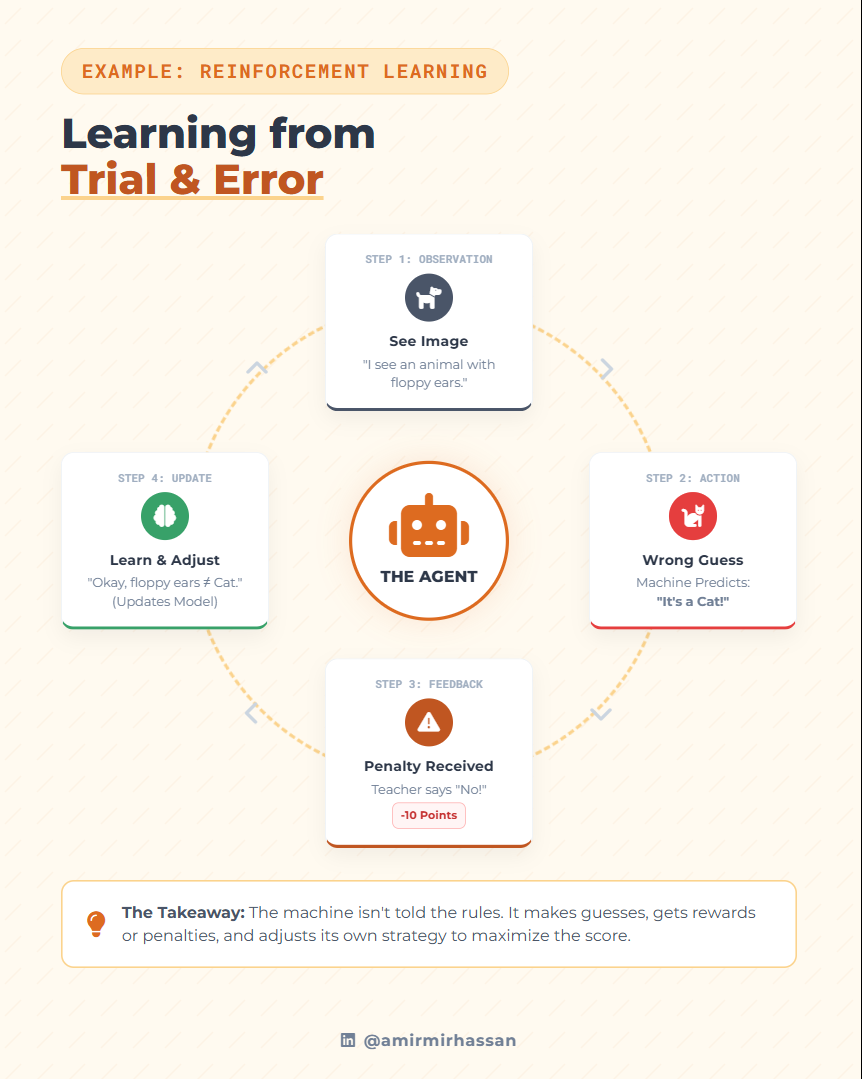
Let’s say you show a machine learning system an image of a dog and ask it to identify what it is.
What happens:
- Initial attempt: The system incorrectly identifies it as a cat
- Feedback: You provide negative feedback, telling the machine “No, that’s wrong. This is a dog’s image.”
- Learning: The machine learns from this correction
- Improvement: The next time it encounters any image of a dog, it will be more likely to classify it correctly
Through repeated interactions like this—trying, receiving feedback, and adjusting—the machine gradually learns to make better predictions.
Key takeaway: This process of learning through feedback, rewards, and penalties is called reinforcement learning. The machine learns the best actions by experiencing the consequences of its choices.
How a Machine Learning Model Works (General Flow)
Here’s the general process that most machine learning models follow:
- Input: Data is fed into the machine learning model
- Algorithm Applied: The model processes the input using a chosen algorithm
- Output: The model produces a prediction or result
- Feedback Loop:
- If the output is correct → it’s accepted as the final result
- If it’s incorrect → feedback is provided to the model, which adjusts and tries again
- Repeat: This cycle continues until the model learns and improves its accuracy
Quick Quiz: Test Your Understanding
Can you identify whether the following scenarios use supervised or unsupervised learning?
Scenario 1: Facebook recognizes your friend in a picture from an album of tagged photographs.
Scenario 2: Netflix recommends new movies based on someone’s past viewing choices.
Scenario 3: Analyzing bank transaction data for suspicious patterns and flagging potential fraud.
Answers: 1 – Supervised, 2 – Supervised, 3 – Unsupervised
Machine Learning Applications
Machine learning is everywhere in our daily lives, often working invisibly behind the scenes. But why has machine learning become so prevalent now? And where exactly is it being used?
Why is Machine Learning Possible Today?
Machine learning isn’t a new concept—researchers have been working on it for decades. However, three major developments have made it practical and powerful in the modern era:
1. Massive Amounts of Data
Today, everyone is online—making purchases, browsing websites, posting on social media, streaming videos. Every single action generates data. This creates an enormous amount of information every minute.
Why does this matter? Data is the key to machine learning. The more data available, the better machines can learn patterns and make accurate predictions. Without sufficient data, machine learning models can’t perform well.
2. Increased Memory Capacity
Modern computers have dramatically increased memory capabilities. They can store and process huge datasets without delays or crashes. This allows machine learning models to work with millions or even billions of data points simultaneously.
3. Powerful Computational Resources
Today’s computers possess incredible processing power. Complex machine learning algorithms that would have taken weeks to run decades ago can now complete in minutes or hours. This makes it practical to train sophisticated models and deploy them in real-world applications.
Real-World Examples of Machine Learning
Machine learning is transforming industries across the board. Here are some fascinating applications:
Healthcare: Predictive Diagnostics
Machine learning models can analyze medical images, patient records, and symptoms to predict diagnoses. These predictions assist doctors in making faster, more accurate medical decisions and catching diseases earlier.
Sentiment Analysis on Social Media
Tech companies use machine learning to analyze millions of social media posts and understand public opinion. This helps them:
- Gauge customer satisfaction
- Identify trending topics
- Understand emotional responses to products or events
Finance: Fraud Detection
Banks use machine learning to detect fraudulent transactions in real-time. The models learn normal spending patterns for each customer and flag unusual activities that might indicate fraud—protecting your money 24/7.
E-commerce: Predicting Customer Churn
Online retailers use machine learning to identify customers who are likely to stop using their service. By predicting “churn” (customer departure) early, companies can take action to retain valuable customers.
Ride-Sharing: Surge Pricing (Uber, Lyft)
Have you ever noticed that your ride fare increases during rush hour or bad weather? This is called surge pricing, and it’s powered by machine learning.
How does it work?
Ride-sharing companies use machine learning models that analyze multiple factors in real-time:
- Current demand for rides
- Number of available drivers in the area
- Weather conditions (rain, snow, etc.)
- Time of day (rush hour vs. off-peak)
Based on these factors, the model adjusts prices dynamically. While this might seem frustrating when prices go up, it serves an important purpose: it ensures that those who urgently need a ride can get one, even during peak times.
These companies also use predictive modeling to anticipate where demand will be high. This allows them to:
- Direct drivers to areas where they’ll be needed
- Minimize surge pricing by balancing supply and demand more efficiently
- Reduce customer wait times
Voice Assistants: Siri, Alexa, Google Assistant
When you say, “Hey Siri, can you remind me to book a cab at 6 PM today?” and it responds, “Okay, I’ll remind you,” multiple machine learning models are working together:
- Speech recognition converts your voice to text
- Natural language processing understands what you’re asking
- Task planning creates the reminder at the right time
All of this happens in seconds, making voice assistants feel almost human.
Conclusion
Machine learning is revolutionizing how computers solve problems. Instead of programming every possible rule, we now teach computers to learn from data—finding patterns, making predictions, and improving over time.
We’ve explored:
- What machine learning is and why it’s more powerful than traditional programming
- Three types of machine learning: supervised (learning with labeled data), unsupervised (finding patterns in unlabeled data), and reinforcement (learning through feedback)
- Real-world applications that touch our lives every day
The best part? This is just the beginning. As data grows, computers become more powerful, and algorithms improve, machine learning will continue to transform every aspect of our world.
Whether you’re interested in healthcare, finance, entertainment, or any other field, understanding machine learning gives you insight into the technology shaping our future. And now, you have the foundational knowledge to explore this exciting field further!