Data Science Job Roles Explained: Data Analyst vs Data Engineer vs Data Scientist vs ML Engineer
📚 Table of Contents
Introduction
If you are just starting to learn data science or machine learning, you might have come across a confusing situation. You open a job search website, type something like “data science jobs,” and suddenly you see a flood of different job titles — Machine Learning Engineer, Data Scientist, Data Analyst, Data Engineer — and you wonder: Wait… aren’t these all the same thing?
This confusion is completely normal. All these roles live inside the same big world of data and machine learning. But they are not the same job. Each one has its own responsibilities, its own required skills, and its own place in the process of building data-driven products.
This article will walk you through each of these four key roles — clearly, simply, and from the ground up. By the end, you will know exactly what each role does, what skills you need for each one, and which path might be the right fit for you.
💡 Pro Tip: After reading this article, visit a job search website like LinkedIn, Indeed, or Internshala. Search for each of these job titles and read actual job descriptions posted by companies. This is the best way to see exactly what skills employers are looking for right now.
Why Are There So Many Different Roles?
Before we dive into each role, let’s first understand why these different jobs exist in the first place.
Think about building a big mobile app — like a shopping app similar to Amazon or Flipkart. That app does not get built by just one person. There are designers, backend developers, frontend developers, testers, and more. Each person specializes in one part of the process.
The same idea applies to building a machine learning product.
Creating a machine learning product is a long, multi-step journey. This journey is often called the Machine Learning Development Life Cycle (MLDLC). Here are the key stages:
- Planning — What problem are we solving?
- Data Gathering — Where does the data come from?
- Data Processing — How do we clean and organize the data?
- Model Training — How do we teach the machine to learn?
- Algorithm Development (Modeling) — Which algorithm should we use?
- Evaluation — How good is our model?
- Deployment — How do we make the model available to real users?
- Optimization — How do we keep improving it over time?
Now ask yourself: Can one single person handle all of these stages well? In a large company — absolutely not. It’s too much work, and each stage requires very different skills.
So companies divide this work among specialized professionals:
- Data Engineer → Handles data collection and infrastructure
- Data Analyst → Understands and explains past data
- Data Scientist → Builds predictive models using data
- ML Engineer → Deploys and maintains those models in real products
Let’s explore each one in detail.
Data Engineer
The Problem: Where Does Data Come From?
Imagine you work at a company like Flipkart. Every second, thousands of users are browsing products, clicking buttons, placing orders, and making payments. All of this activity generates massive amounts of data — and this data is stored in what’s called an OLTP database (Online Transaction Processing database).
An OLTP database is like a live, always-running engine. It is designed to handle millions of small transactions at high speed. It keeps the website and app running smoothly for users in real time.
Now here’s the problem: What if a data analyst wants to run a complex analysis on this data — like “What were our best-selling products last year?” — directly on this live database?
That would be a disaster. Running heavy analysis queries on a live OLTP database can:
- Slow down the website for real users
- Corrupt or mess up live user data
- Cause the app to crash
The Solution: Data Warehouses and OLAP
This is exactly where the Data Engineer comes in.
A Data Engineer takes data from the live OLTP database and moves it into a separate system called an OLAP database (Online Analytical Processing), also known as a Data Warehouse.
Think of it like this:
- The OLTP database is like the kitchen of a restaurant — busy, fast, and not a place for visitors.
- The Data Warehouse (OLAP) is like a clean, organized report that gets printed after the day is done — safe to read, analyze, and share without disturbing the kitchen.
This separation means analysts and scientists can study the data freely without ever touching the live system.
Core Responsibilities of a Data Engineer
- Building Data Warehouses (OLAP systems): Setting up the analytical databases where data is stored for safe and efficient analysis.
- Handling Multiple Data Sources: Data doesn’t always come from just one place. It might come from the company’s own database, third-party APIs, or even web scraping (automatically collecting data from websites). The Data Engineer connects all of these sources together.
- Building Data Pipelines and APIs: A data pipeline is like an automated conveyor belt that moves data from one place to another automatically. Data Engineers build these pipelines so data flows smoothly and reliably.
- Database Maintenance: They continuously monitor the infrastructure, fix any broken pipelines, ensure data quality, and keep everything running without errors.
Why Is This Role So Important?
Data is often called “the new gold.” Without a Data Engineer, no one else — not the analyst, not the scientist, not the ML engineer — can do their job properly. The Data Engineer is the foundation of the entire system.
Because of this critical importance and the specialized skill set required, Data Engineers are in very high demand and earn excellent salaries, especially in large organizations.
Required Skills for a Data Engineer
- Strong Software Engineering Background — Backend systems, server management, and databases
- Algorithms and Data Structures — For writing efficient code that handles large amounts of data
- Programming Languages — Java, Scala, or Python
- Database Knowledge — Both SQL (structured databases) and NoSQL (unstructured databases)
- Big Data Tools — Apache Spark, Hadoop, Hive
- Cloud Platforms — AWS (Amazon Web Services), GCP (Google Cloud Platform), or Microsoft Azure
- Distributed Systems and System Design — Understanding how to build systems that run across many computers
- Data Orchestration Tools — Apache Airflow for automating and managing complex data workflows
Data Analyst
The Problem: We Have Data, But What Does It Mean?
Let’s say the Data Engineer has done their job perfectly. The data warehouse is ready. Millions of records are sitting there, neatly organized.
But now, the company’s management team has a question: “Why did our profits drop last quarter? Why is this product not selling well? Which region has the most loyal customers?”
Someone needs to dig into that data, find the answers, and explain them clearly to people who might not understand numbers and spreadsheets. That person is the Data Analyst.
Core Responsibilities of a Data Analyst
- Cleaning and Organizing Raw Data: Even well-stored data can be messy — missing values, duplicate entries, wrong formats. The analyst cleans this up first.
- Analyzing Data: Running queries and calculations to find patterns, trends, and insights.
- Creating Data Visualizations: Instead of handing management a table of 10,000 numbers, the analyst turns those numbers into clear, beautiful charts and graphs that tell a story at a glance.
- Producing Reports and Presentations: Creating PowerPoint slides and dashboards to present insights in meetings.
- Collaborating with Other Teams: Understanding what questions each team needs answered and explaining findings in plain language.
- Optimizing Data Collection: Suggesting better ways to collect data so future analysis becomes easier and more accurate.
Data Analyst vs Business Analyst
You might also hear the term Business Analyst. These roles are very similar, but there is a key difference:
| Data Analyst | Business Analyst |
|---|---|
| Focus on technical tools and databases | Focus on business strategy and management |
| Background in engineering or computer science | Often MBA or business background |
| Tools used: Python, R, SQL | Tools used: Tableau, Power BI, Excel |
Both extract insights from data, but a Data Analyst is more technical, while a Business Analyst is more management-oriented.
Required Skills for a Data Analyst
- Good Understanding of Statistics — To interpret numbers correctly and draw valid conclusions
- Programming Languages — Python or R for data manipulation
- Strong Analytical Thinking — The ability to look at data and find meaningful patterns using logic and common sense
- Business Acumen — Understanding the industry you work in. For example, if you analyze cricket data, you need to know what “strike rate” or “economy rate” means to make sense of the numbers
- Strong Communication Skills — Being able to explain findings to non-technical people like managers and executives
- Data Mining — Basic techniques for discovering patterns in large datasets
- Data Visualization — Creating charts, graphs, and dashboards
- Data Storytelling — This is considered an art. It’s the ability to take complex data insights and present them as a clear, engaging, easy-to-understand story. This skill separates great analysts from average ones.
- SQL — For querying databases
- Excel — Especially useful for Business Analysts, but helpful for Data Analysts too
Data Scientist
Who Exactly Is a Data Scientist?
Here is one of the most famous and accurate descriptions of a Data Scientist:
“A Data Scientist is someone who is better than a statistician at software engineering, and better than a software engineer at statistics.”
In other words, a Data Scientist sits right in the middle — combining strong mathematical and statistical knowledge with solid programming and software skills.
The Difference Between a Data Analyst and a Data Scientist
This is one of the most common points of confusion. Here’s the simplest way to think about it:
- Data Analyst → Looks at the past. “What happened? Why did it happen? How did it happen?”
- Data Scientist → Looks at the future. “What is likely to happen next? How can we use data to predict and prepare for it?”
Real-World Examples of Data Scientist Work
- Building a recommendation engine that suggests products to users based on their browsing history — increasing sales automatically.
- Optimizing delivery routes for a logistics company to save time and fuel costs.
- Predicting customer churn — which customers are likely to stop using a service — so the company can reach out to them before they leave.
The “Full-Stack” Data Professional
A Data Scientist is often called a full-stack data professional. This means they can handle almost all parts of the Machine Learning Development Life Cycle on their own.
- In a startup, a Data Scientist might also do the work of a Data Engineer (collecting and preparing data) and a Data Analyst (reporting insights).
- In a large company, they focus mainly on building, testing, and improving machine learning models.
If you are studying machine learning, becoming a Data Scientist is one of the most well-rounded and rewarding goals you can aim for.
Key Responsibilities of a Data Scientist (In a Large Company)
- Reading and interpreting reports produced by Data Analysts
- Creating and refining machine learning models
- Ensuring models perform as accurately and efficiently as possible
Required Skills for a Data Scientist
- Knowledge of All Algorithms — Machine learning and deep learning algorithms
- Strong Math Skills — Linear algebra, calculus, probability, and statistics
- Software Skills — Good programming knowledge (not as deep as a Data Engineer, but solid)
- Excellent Communication Skills — They talk to Data Engineers to get data, and to ML Engineers to deploy models. Clear communication is essential.
- Strong Analytical Thinking — For solving complex, open-ended problems
- High Business Acumen — Building models that actually solve real business problems requires deep domain understanding
- High Data Storytelling Ability — Presenting complex model results in a way that non-technical executives can understand
- Programming Skills — Python or R
- Understanding of Distributed Systems and System Design — To think about how models will scale and perform in real production environments
ML Engineer (Machine Learning Engineer)
The Problem: The Gap Between Science and Software
Let’s say a Data Scientist has worked for weeks and finally built an amazing machine learning model. It can predict customer behavior with 95% accuracy. Everyone is excited.
But now comes the real challenge: How do we actually put this model inside our app so real users can benefit from it?
Here’s the problem:
- Data Scientists are experts at building models, but they often don’t have deep software engineering skills needed to deploy and scale those models in a live environment.
- Traditional Software Developers are experts at building apps, but they don’t understand machine learning models well enough to integrate them correctly.
This creates a gap — and that gap is exactly where the ML Engineer steps in.
Core Responsibilities of an ML Engineer
- Deploying ML Models: Taking a trained machine learning model and embedding it into a live product — like making a recommendation engine actually work on a live website.
- Optimizing Models for Production: Ensuring that the deployed model runs fast, handles high traffic, and produces results efficiently. This includes decisions like: How often should the model be retrained? How should new data flow into it? How do we back up the model?
- Monitoring and Maintenance: Tracking model performance over time. If a model starts producing wrong results (a common problem called “model drift”), the ML Engineer detects and fixes it.
Required Skills for an ML Engineer
- Production-Ready Model Handling — Experience taking models from a notebook/experimental stage to a live, scalable system
- Strong Programming Languages — Python, Java, or similar
- Distributed Systems — Understanding how to build systems that work across many machines
- Model Deployment Knowledge — Tools and techniques specifically for deploying ML models (e.g., Docker, Kubernetes, REST APIs, model serving frameworks)
- Machine Learning Algorithms — A good understanding of how models work, even if they don’t build them from scratch
- Software Engineering Concepts — Solid general software development principles
- System Design — Designing the architecture of large-scale, reliable ML systems
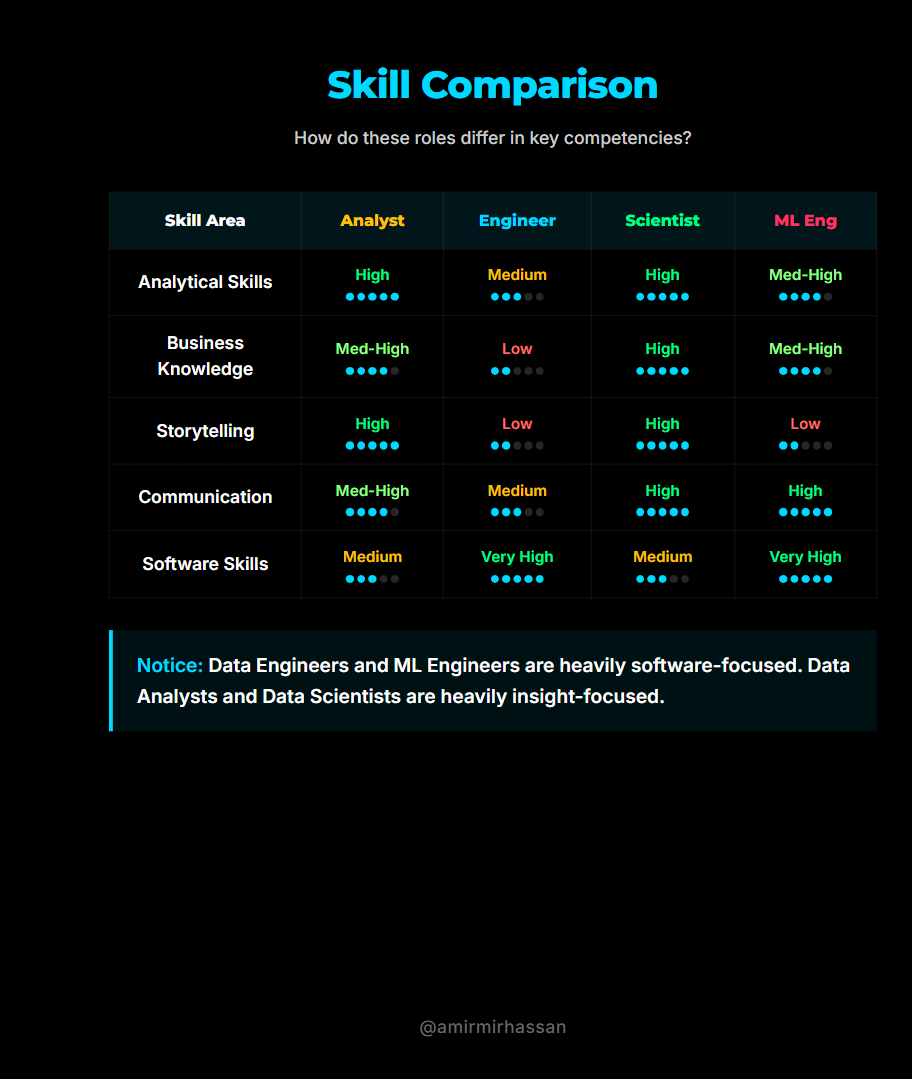
Comparison of All Four Roles
Now that we’ve looked at each role individually, let’s compare them side by side. This will help you see the big picture clearly.
| Skill / Attribute | Data Analyst | Data Engineer | Data Scientist | ML Engineer |
|---|---|---|---|---|
| Analytical Skills | High | Medium | High | Medium to High |
| Business Acumen | Medium to High | Low | High | Medium to High |
| Data Storytelling | High | Low | High | Low |
| Soft Skills / Communication | Medium to High | Medium | High | High |
| Software Skills | Medium | Very High | Medium | Very High |
Let’s break down each row:
Analytical Skills / Common Sense — A Data Analyst needs strong analytical thinking to extract meaningful insights from raw data. A Data Engineer focuses more on infrastructure, so medium analytical skills are enough. A Data Scientist needs very high analytical skills to build and interpret complex models. An ML Engineer needs medium-to-high analytical skills for troubleshooting and optimizing deployed systems.
Business Acumen — A Data Analyst needs to understand the business context of the data they’re analyzing. A Data Engineer’s work — building pipelines and databases — is largely domain-agnostic. (A Data Engineer who worked at Zomato could easily move to Flipkart with the same skills.) A Data Scientist needs deep business understanding to build models that actually solve real problems. An ML Engineer needs medium-to-high business knowledge to understand how models fit into the overall product.
Data Storytelling — A Data Analyst must be a great storyteller — this is how they communicate insights to management. A Data Engineer rarely needs this skill. A Data Scientist must also tell stories clearly, since they present complex model results to multiple teams. An ML Engineer focuses on deployment, not narrative — so storytelling is less critical.
Soft Skills / Communication — A Data Analyst regularly presents to different teams, so medium-to-high communication skills are needed. A Data Engineer collaborates with other engineers, requiring medium communication skills. A Data Scientist communicates with almost every team in the pipeline — making high communication skills essential. An ML Engineer acts as a bridge between Data Scientists and Software Developers, so high communication skills are very important.
Software Skills (Programming, Data Structures & Algorithms, Distributed Systems, System Design) — A Data Analyst needs programming (Python or R) but doesn’t need deep knowledge of data structures, algorithms, or distributed systems. A Data Engineer needs very high software skills — they are essentially specialized software engineers. A Data Scientist needs solid programming skills and some software engineering, but not as deep as a Data Engineer. An ML Engineer needs very high software skills because deploying and managing ML systems at scale requires serious engineering expertise.
Which Role Is Right for You?
Here’s a simple guide to help you decide:
Choose Data Scientist if you want to enter the data and machine learning field in a comprehensive, well-rounded role. It’s one of the most in-demand and well-compensated paths, and it covers a wide range of the machine learning life cycle.
Choose Data Engineer if you have a strong software engineering background and enjoy building large-scale data infrastructure. If you love working with databases, pipelines, and distributed systems — and want an excellent salary — this is a great path.
Choose Data Analyst if you love exploring data, uncovering stories from past trends, and communicating insights to others — but don’t want to dive deep into complex mathematics or advanced machine learning algorithms.
Choose ML Engineer if you are passionate about taking machine learning models and making them work reliably in real-world products. If you enjoy the intersection of software engineering and AI systems, this is your role.
How to Find Out What Skills You Actually Need
Here’s the most honest and practical advice: don’t rely only on articles or courses to tell you what skills to learn.
Instead, visit a job search website right now — LinkedIn, Indeed, Internshala, or any platform in your country. Search for the specific job title you’re interested in. Open 10–15 real job descriptions posted by actual companies.
Read what they are asking for. Look at:
- Required programming languages
- Tools and frameworks listed
- Educational qualifications
- Years of experience expected
This is the most direct and up-to-date way to understand what skills the industry actually values. Job descriptions are essentially a roadmap — they tell you exactly what to learn to get the job you want.